

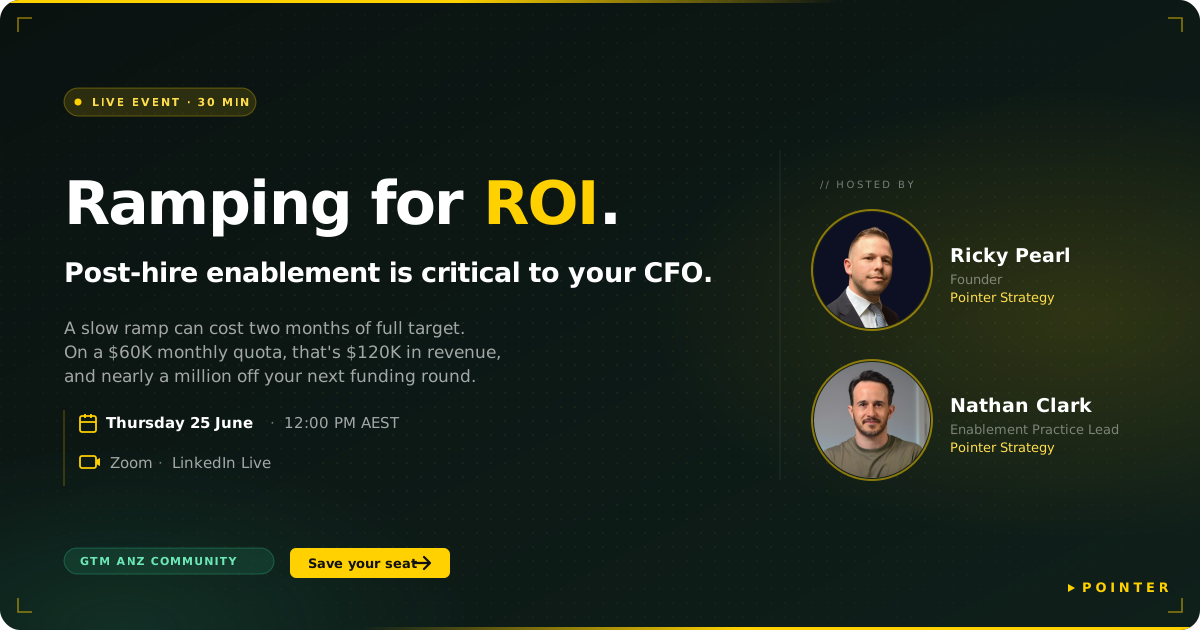
This is a recording of a live session from the GTM ANZ Community, featuring Ricky Pearl (Founder, Pointer Strategy) and Nathan Clark (Enablement Practice Lead, Pointer Strategy & Founder, Upright Revenue).
Why Ramp Is Suddenly the Most Important Thing You Do
There's a moment in every growing company where ramp stops being a nice-to-have. You raise a round. You find product-market fit. International expansion lands on the cards, or you launch a whole new product line and start hiring for it. Suddenly the speed at which you turn a new employee into a productive person who can retire quota becomes tremendously important.
The maths makes the point on its own. If you're adding reps and you can pull one month of closed deals forward, with 10 reps and an average deal around $30K, that's roughly $300,000 of incremental revenue you didn't have before. The more attention and systems thinking you apply to ramp, the more likely you are to get the outcome you want.
So before diving into the numbers too sharply, Ricky Pearl and Nathan Clark started where every useful conversation about ramp has to start: what does "ramp" actually mean?
There Are Two Ramps, and People Confuse Them
Most people think about ramp the same way they think about any employee onboarding. Have we taken them through the company's onboarding process? Have they learned the tools, learned the business, can they articulate the value proposition and work autonomously? That's onboarding — and onboarding and ramp are connected, but they are not the same thing.
A useful way to separate them:
On top of that, the word "ramp" itself gets used for two completely different things:
| What it measures | When it goes wrong | |
|---|---|---|
| Quota ramp | How a rep's target scales — e.g. 0% in Q1, 25% in Q2, 50–75% in Q3, 100% in Q4 | Too slow and you overpay for output; too fast and the rep under-earns and starts eyeing the exit |
| Capability ramp | Whether the person can actually display the behaviours, skills, knowledge and process to hit that number | Slips quietly while everyone watches the quota schedule instead |
"A model is fiction. It's a story that we hope comes true. The work you do in the ramp is how you turn fiction into nonfiction." — Nathan Clark
The quota ramp is the plan. The capability ramp shows up in the actual bookings — the ARR or MRR you're adding this week, this month. One can go really well while the other doesn't, so don't let the two definitions blur together.
A Salary Is a Bet on Revenue, Not Just an Expense
Most roles have an economic justification underneath the salary. Someone decided you need a sales executive, justified it in the headcount plan, tied it to the budget and the expected revenue, and a CFO looked it over and agreed the expenses made sense *given that revenue*.
The trap is that we obsess over the expense side and forget the revenue side that it's supposed to unlock. Two things get overlooked:
The $10K Trap: Where Sales Leaders Quietly Lose Millions
Here's the maths, with the edges smoothed for easy numbers. Say a rep is on $200K OTE, split 50/50 — $100K base. Take a 5x OTE target, so $100K of base is meant to generate around $1M.
Now you "win" the negotiation and get them in $10K cheaper. Or you refuse to stretch the last $10K and lose the candidate who would have closed an extra $100K this year.
"We saved $10,000 this year on a salary — and we missed out on the $990,000 of enterprise value." — Ricky Pearl
That $100K in missed revenue isn't just $100K. Run it through the lenses your CFO actually uses:
Either way, you went to the ends of the earth to save $10K and walked past close to a million dollars. The reason this happens so often is that sales leaders aren't empowered with the big picture. They're held to an exact budget and kept away from the revenue story behind it. The fix is to put on the CRO hat and think like a true executive about what the hire means for the business holistically — even (especially) if you're a first-time CRO doing it for the first time.
Cost the Hire Over Six Months, Not on Day One
Reframe the expense. Don't ask "are we paying $100K base?" Ask what does this person cost me over six months, relative to the income they bring in over six months?
In that frame, a candidate at $120K base who has done the role before, hits the ground running, onboards faster and starts producing revenue sooner can be *significantly cheaper* over six months than the $100K hire who takes longer to get there. You're no longer pricing the day they start. You're pricing time to value.
That same logic shows up in how Pointer talks about guaranteed ramp when advertising roles. If a rep's average sales cycle is six months, there's no way for them to self-source revenue in their first six months — so you pay them as if they're at target during that period (sometimes with a clawback, sometimes just guaranteed). In that context "ramp" only means quota. The conversation here is about the other side: the rep's actual capability.
Before You Hire: The Right Person Through the Right Process
A faster ramp starts before anyone signs. Group the pre-hire work into one job: find the right person. To do that well you need:
There's also a data point worth using: where you have evidence that hiring inside your industry accelerates ramp, it can speed up selection too. Clarity over the skills, knowledge and attributes the role needs makes the whole front end sharper.
The MVP of Ramp: Skills Are the Atomic Unit
So what's the minimum viable version of a ramp program — from two months before you hire to six months after they start?
"The atomic unit of enablement is a skill." — Nathan Clark
Work backwards from the behaviours that are *causal* to results. We know we create urgency when we ask great questions below the surface-level pain. We know we convert demos at a higher rate when we personalise based on real discovery. We know we get more meetings when we reach out to the right ICP and persona. Draw a line around the role as a collection of those skills.
The MVP looks like this:
This is how onboarding and ramp become "a factory for quota retirement" rather than time served.
Sequence the Skills, Don't Assess Readiness Too Early
There's a real art to the order. Companies new to this tend to fail in one of two ways.
The first is treating ramp as time and consumption — death by LMS. Have you sat through the training? Have you been here 90 days? That measures attendance, not capability.
The second is more subtle: assessing readiness prematurely. Take demoing the product. Don't critique a rep's first practice demo on the nuance of competitive positioning. Build it in layers:
"If we're learning a serve in tennis, only ever focus on one thing per drill. As soon as you try to do three or four things at once, you do nothing." — Ricky Pearl
That's not a sales instinct — it's a theory of education, and most sales leaders were never taught it. It isn't a skill you pick up as an account executive. The good news: between the enablement profession and the volume of material now available, you can adopt the practices from day one, and bring in dedicated help once the volume of hiring justifies it. If you're hiring six people this year, the accretive value of getting them productive faster pays for it easily.
Build the Factory — Then Keep Maintaining It
Ramp isn't a one-time build. Standards change as you grow. Three founders who trusted each other ran great deals on instinct; six people start dropping deals through the cracks. That's when you need to establish a process — and the cleanest way to embed it is *through* the ramp.
Write the new process as if you're reading it for the first time on day 15 or day 37. Distil it that way, drop it into onboarding, and the two feed each other: the ramp experience matures as the process matures.
The same muscle handles every change that follows:
Nathan is running exactly this with a client right now — a big launch on July 15, marketing building content, training delivered last week. When he asks the team how confident they'd be walking a prospect through it today, the answer is low, and that's fine. There's time. So they run practice workshops, simulate the experience, and build the FAQ and the infrastructure around the rep.
"There's no world where you just buy the machines and leave them in the box. You've got to set up the factory, and keep it lubricated and maintained." — Nathan Clark
The goalposts keep moving — new products, price changes, new territories, a competitor arriving. If you're building to scale, ramp requires a level of intensity that's impossible to bolt onto a revenue leader's day job.
The Gotchas
Where teams go wrong, repeatedly:
The Bottom Line: You Can't Save Your Way to Success
The whole game is one metric: what can I do as a revenue leader to reduce time to value?
Run the numbers one more time. A rep costing ~$20K a month who ramps in four months instead of six isn't just "two months cheaper." Spend the same $60K — but on enablement, so they ramp in four months instead of coasting to six — and you start collecting revenue at month four instead of month six. By the end of the financial year that's two extra months of revenue in the door. You've changed the whole economics.
"People go to the ends of the earth to negotiate a rep down $10K when hiring them, then let them loose into the ether to fail. Four months of salary, four months of time, and you start again. You cannot save your way to success in a revenue team." — Ricky Pearl
Key Takeaways
Want a faster ramp on your next hire? Every Pointer placement includes 12 months of structured training and enablement — so your new rep doesn't just get vetted by practitioners, they get coached to productivity from day one. Book a discovery call.
Your Speakers
Ricky Pearl is the Founder of Pointer Strategy, where he's worked with 200+ GTM teams in APAC on strategy, hiring, and implementation.
Nathan Clark is the Enablement Practice Lead at Pointer Strategy and Founder of Upright Revenue, where he works with founders and GTM leaders to turn revenue uncertainty into repeatable performance.
*This session is part of the weekly GTM ANZ Community series. Join free for conversations on revenue enablement, hiring, go-to-market engineering, and AI — every Thursday.*
<details>
<summary><strong>Full Transcript</strong></summary>
Ricky: As soon as there's this moment where you go — okay, maybe I've just raised a round, maybe I've got product-market fit, maybe I've got international expansion on the cards, maybe I'm launching a whole new product line and I'm hiring for that — the repeatability of this time period where we turn someone from employee to productive person who can go and retire quota becomes tremendously important. And the more attention and systems thinking you can apply to it, the more likely you're going to get the outcome you want. As soon as you're adding more reps, if the difference is one month of deals closed that we can pull forward, and we've got 10 reps and an average deal is, say, $30 grand, that might be $300,000 of incremental revenue you didn't have.
Nathan: Let's zoom out a little before we dive into those numbers too sharply. Let's just start with — how do we define ramp?
Ricky: I'm curious — what do you hear back when you speak to businesses? What do you hear most? And then I'll figure out how to define it.
Nathan: Most people think of ramp the same way they think of any employee onboarding. Have we taken them through the company's onboarding process? They've learned how to use their tools, learned about the business, and they're now able to articulate the value proposition and work autonomously. That's mostly a similar onboarding to other employees.
Ricky: Let's define it. Onboarding and ramping aren't interchangeable, but they're very connected. You should have a very deliberate, intensive, functional role-based onboarding experience inside a GTM team that's separate from company onboarding — company onboarding to me is just company orientation. And we've got role-based onboarding, and it should flow into a ramp period. The stage gate for that first onboarding moment is that someone can carry probably the first half of a deal. Maybe not all the closing motions — we've left it too long if we only consider them onboarded then — but they can go all the way through. And then ramp says we are operating at productivity. I've got a model: reps need to close this amount of revenue, and they're sitting in the band the team operates at.
Nathan: When we think of the connotations of the word ramp — what is ramping up, what's increasing over the period? Very often ramp refers to the slow progression of quota: the first quarter there's no quota, the second quarter maybe 25%, third quarter 50 to 75%, and the last quarter maybe 100%. That's your quota ramp. There's also the ramp of your capabilities and your ability within the organisation to do the job.
Ricky: They're two sides of the same coin. Companies are typically pretty good at delineating the quota ramp — whether you agree with the exact scale is up for debate, some reps think it's too aggressive — but most companies have a view of it and put those timestamps down. The other side is whether the person can actually show up and deliver. That's what defines the ramp itself: are they able to display the behaviours, the skills, the knowledge, and adhere to the processes necessary to actually get the number? That's how I think about ramp — working backwards from the quota, the productivity, where we need to be and when.
Nathan: And it's good not to let those two definitions blur, because they're used slightly differently and one can go really well while the other isn't great. You can ramp quota too slowly, in which case you're paying high salaries; or too quickly, in which case the rep earns less and starts thinking they need an exit. We also use it in terms of guaranteed ramp. When we advertise roles and say there's guaranteed ramp, we mean you'll earn your on-target earnings during the ramp period because there was no opportunity to close deals — if your average sales cycle is six months, there's no way to bring in self-sourced revenue in the first six months. We pay you as if you're doing that, then there's either a clawback system or it's just guaranteed. In that sense, when we talk about ramp we're only talking about quota, not someone's ability to do the role. It's often used interchangeably, but for this conversation we really want to focus on the rep's capability side of a ramp program, which of course relates to revenue and quotas.
Ricky: You put it very well, and it's worth drawing a line between the two. If you're a sales leader and you've written your sales model, you've got your targets for the year, you've worked out when you'll hire, and you've factored in revenue coming in at certain points. It's one thing to design the quota ramp. It's another to look at the actual bookings, the actual ARR or MRR you're adding this month, this week. That's where the actual rep ramp shows up — in the real results you're getting today. A model is fiction. It's a story we hope comes true. The work you do in the ramp is how you turn fiction into nonfiction.
Nathan: So let's dive into that. Most roles — it depends on the stage of the business — have some economic justification underpinning the salary. We needed a sales executive, for example, and we justified it in our headcount planning, which relates to expenses and budgets and the expected revenue goals. The CFO has probably looked over the plan and said, yeah, this makes sense given this revenue. Those expenses might not make sense if the revenue changes.
Ricky: The salary itself — the fact the role even exists — relates to both a budget, an expense, and an expected revenue. We often focus on the budget: now we have the salary, we negotiate hard to get people within it. But there are a few factors that influence that expense, and importantly the revenue related to it, that are often overlooked. The first part is actually hiring the right person.
Nathan: We see this very often. On the expense side, the timing of the expense makes a huge difference. If you delay your hiring by six months, you're essentially spending half your budget for that role for the financial year. The timing of who you employ and how long it takes you to hire impacts how much of the expense you incur, and the timing of the associated revenue. Most sales leaders get that. But they make it harder for themselves by going too hard on the budget, pushing salaries down, which brings in weaker candidates, which expands the hiring process because it takes so much longer to find an outlier who fits your standards.
Ricky: Let's put numbers on this — rough, edges smoothed. I don't do public maths. Say someone's $200,000 OTE, 50/50 split, $100K on the base. Take a 5x OTE for the target, $100K a year. You might find that winning $10 grand on the base — getting someone in cheaper, or not being able to stretch another $10K — means you lose someone who could have closed an extra $100 grand this year. And $100,000 in missed revenue on a 10x might be a million dollars of enterprise value you missed out on. Because, oh great, we saved $10,000 this year on a salary — and we missed out on the $990,000 of enterprise value.
Nathan: To explain some of that maths — particularly for companies raising funds. The $10 grand they saved, we all understand. But if this person could bring in an extra $100,000 in ARR, you might be getting a 10x return at your next capital raise. So they might bring in an additional million dollars. Or if you're not looking at the whole capital cycle, you might have an average customer lifetime contract value of over 10 years, so we're talking a million dollars of total value. This is so overlooked. Part of it is that sales leaders aren't empowered with the big picture. They're pressed on the bottom line of the budget, often kept in the dark or told to come within this exact budget. There's a much bigger picture at play that CROs should be more focused on. As a sales leader you should put on the CRO hat and think like a true executive about what this means for the business holistically.
Ricky: And even first-time CROs — with these younger companies, it's often the first time you've had to think it all the way through. But we're here to talk about ramp. So how do we unlock this productivity out of reps? I'd argue there isn't enough attention and systemisation — turning it into a real factory for quota retirement. That's how I think about onboarding and the subsequent ramp.
Nathan: To summarise what we've covered: when we think about the expense of a role, we don't want to just think about salary. We want to think about their expense relative to their income over a period of time. What is this person costing me over six months, relative to the income they bring in over six months? In that frame, a person who comes in at $120K base instead of $100K — who's done the role, can hit the ground running, onboards much quicker and reduces time to value, bringing in revenue sooner — when you cost it out over six months, it was significantly cheaper to hire the more expensive person. So we start with a frame of a larger period than just the day they start.
Ricky: So practically, what are some things we can do before we hire that reduce the time to value for the person we hire?
Nathan: Having clarity over the skills and knowledge. If we have data that tells us hiring inside the industry accelerates things, that makes the selection process itself a big deal. And there's an employer-brand perspective to attracting the right people.
Ricky: If we group all the pre-hire stuff: finding the right person. To find the right person, the role has to be designed well and be attractive — how we shape the role, how we brand the company, the employer brand. Then your interview and hiring processes, because you can easily waste a month hiring, and that impacts the end goal. You might lose better candidates if your process is too long or too slow. But ultimately it comes down to hiring the right person with the right skill sets, relative to the process they're going into. If you don't have the capabilities to hold someone's hand, you have to hire someone more autonomous. If you've got a really excellent process for them to come into, you might not. It's a balancing act, but it starts with the right person through an efficient, well-structured hiring process.
Nathan: That translates directly into the ramping experience. I work backwards from the behaviours that are causal to results. We get urgency when we ask great questions below the surface-level pains. We convert demos at a higher rate when we personalise based on the discovery we've done. We get people onto calls more regularly when we reach out to the right ICP- and persona-specific people. You can draw a line around a role based on a collection of these skills. The whole ramping experience is about how I build experiences and learning moments, but also testing outcomes that are increasingly more complex and more commercial — and making sure we're actually seeing it, validating it, getting reps to show they've got the capability and increasingly earning the right to go and do the job.
Ricky: Earning the right to do the job — not just being dropped in at sink or swim. When you've had an excellent hiring process and drawn a line around the skills — say the 30 core behaviours a person needs in this role — you can interview for that, find ways to screen and validate during the interview. That carries on post-interview at an individual level. We know Nathan's really great at this, we've got a solid understanding. Now we just want to see these 30 things done — and some of them he can't do yet, like articulating the value proposition and our unique positioning relative to the market, competitors and the status quo. He has to learn that. We need a teaching framework, material, someone to deliver it, then to validate it's done right, and environments to practise. Once we're confident in his ability, tick it off — that's done, he can now do that part of the job.
Nathan: It's just sequencing that in the right order. The big thing for me, looking at companies doing this for the first time with less direction, is two failure modes. One is a very consumption-based experience — just time and consumption. Have you sat through the training? Have you practised the thing? We run for 90 days.
Ricky: Death by LMS.
Nathan: Exactly. On the other side — a nuanced point — some sales leaders try to assess readiness prematurely. Say we want someone capable of demoing our product, and it takes two weeks of learning and practice to run a half-decent demo. First, I just want to see: do you get it? Do you know what the product does, where the buttons are, can you go through the core workflows? Then move away from features — can you talk through the core jobs-to-be-done our buyers need, and the benefits of how we do it? Then there's a version where you respond to the discovery you've just done, personalise the pieces that matter, and talk about our product relative to competitors, laying landmines along the way. It's about building this increasingly complex thing and giving feedback relative to that. Sometimes people watch a first practice demo and say, "you said this wrong." Let's not concentrate on that — let's build the building blocks. I'd apply that to all the skills. There's a real art and science to getting it right.
Ricky: I agree, and not all leaders are great at that. It's more a theory of education, particularly in practical skills. If we're learning a serve in tennis, only ever focus on one thing per drill — getting the ball toss in the exact perfect place, don't worry about the rest. As soon as you start thinking you need to do three or four things, you do nothing. So where do sales leaders learn this?
Nathan: It's certainly not a skill you learn as an account executive, or anywhere through your sales journey. I'm too biased for a great answer, I can only give a good one. There's a profession that slots right in around enablement, and great enablement people should bring all of this to the table. Thankfully, access to information like this is out there, so you don't necessarily need someone on day one. If you're serious about growing your business, make the investment — but on day one you can adopt some of these practices yourself, there's enough information out there. Sales enablement, revenue as a profession now — there should be enough to at least get started. And if you're hiring six people this year, the accretive value of getting them more productive, not just in the ramp but over time, and getting your product launches right, easily pays for it.
Ricky: So what's the MVP — the minimum viable product of ramp? What are the core components, looking through the eyes of a revenue leader who wants to hire someone? What are the steps from two months before you hire to six months after they start?
Nathan: You've heard me say this sentence: the atomic unit of enablement is a skill. The first thing I'd do is sit down and say — even if it was me who closed the last 10 deals — what's the 80/20, the 10 skills I think were most necessary to win? I was able to do deep discovery to understand the pains, challenges and opportunities. We sell a highly technical product, so we need someone who's been in industry, hopefully as a practitioner — or we don't, it's an SMB product, fast and transactional, the only way the maths works. Whatever it is, get the core idea of those skills. Then take the extra step — in a world with GPT and Claude, you could say, give me some examples of this, what would I want to see, what does good look like for this skill in our business. Now there's a pretty clear map. When we go to market, I need to test for these things. I can't test for all of them, so I need the key ones in the interview and hiring process, and maybe referrals to validate the rest. Then I make sure we put a lot of attention on building those skills in the first X amount of time. That's the MVP — what are the behaviours, the skills, causal to closing deals? Let's get those right. You stack that on top of culture, but functionally that's where I'd start.
Ricky: What happens when you have changing standards — moving from a tiny team to a bigger team? We never had rock-solid deal-management processes; we ran good deals, but it was three of us, we trusted each other, things were fine. Now there are six of us, things are falling through the cracks. One person runs great deals, another runs some great, some shit. How do you traverse those processes, when it's coinciding with the team growing?
Nathan: A lot of the work I do now in a consulting capacity is this symbiotic thing: as we build the ramping experience, we establish a process and place it into the onboarding motion. We say, here's the new configure-price-quote approach, and write it with the mindset: if I was here on day 15 or day 37 reading or watching this for the first time, what would I need? Distil it that way and it's ready. We keep building in front of us, so the whole onboarding and ramping experience matures over time. They feed each other.
Ricky: We see this when companies bring in MEDDIC, a deal-management framework, or a different methodology. You need that muscle to say, here's a new thing we want to do, how do we teach it? Product teams think, we've built a new feature, sales team go sell it, here's a one-page PDF. But you need the same process: what do we need them to be able to do to sell this product? What's the knowledge, the skills, the attributes? This new feature means we can now sell to the CFO as well as the COO, a new persona — does that change the language we need? What has to be re-taught and re-validated?
Nathan: It's a big piece of work, actually thinking about what the new sales plays are. I'm going through this right now with a client — a big launch, July 15. Marketing are doing a great job building content, and we had training last week on what it is. Then I'm asking the team, how confident would you be walking this through with a prospect today? It's pretty low, and that's okay, we've got the time. So we put the energy in — running actual workshops of practice, simulating the experience, building an FAQ and all the infrastructure around you to support you.
Ricky: One thing I've noticed for sales reps — driven, goal-oriented. Where the sales leader puts in the effort to draw the list of 30 skills they need and what those skills look like in reality, they don't sleep well at night until they've gotten through that list. They're motivated to tick all 30 off. If you haven't built that list, they flounder — "I'm trying, I'm trying" — but it's unstructured. The same frustration happens when the product team releases a new product but we haven't challenged them with why this feature was released, what problem it solves, how it was raised in customer interviews. When you haven't set it up in front of them to achieve, everyone flounders. The goal is: can we understand the finances of a ramp? If someone is costing us $10 grand a month — using your easy maths, $10K base, $10K OTE, so $20 grand a month, $200K a year — if they ramp in four months instead of six, they're driving revenue after we've only spent $40 grand instead of $60 grand. There's a huge difference there. And the difference isn't just $20 grand. If you actually spent the $20 grand to ramp them quicker, at four months it still costs you $60 grand — versus that $60 grand over six months because you didn't spend on enablement. The difference is at month four you're getting your first dollar, instead of month six. So by the end of the year — months 10, 11, 12 — you've got two extra months of revenue coming into that financial year. You've materially changed the whole economics. So in almost every scenario, you'd rather spend $60 grand to ramp in four months than spend $60 grand over six months. You're paying less each month but taking longer. The goal for everyone is: what can I do as a revenue leader to reduce time to value? That's the be-all and end-all. So where are the gotchas — where are people going very wrong?
Nathan: A number of things. One I mentioned — thinking about this from a time-and-consumption perspective. I'm very focused on building the skills that give us the leading indicators that tell us we'll get the commercial outcomes we want. So not having the instrumentation, the testing along the way that gives those leading indicators, and being clear about that. You mentioned the structure piece — the amount of times I've said to reps, "you're exactly where you need to be," and that being an important part of their journey is a lot. So: structure, clarity, and holding very high standards. It's easy to let things slip. We talk about accelerating the ramp, getting them to productivity — I've seen executives decide "we need someone to cover this now, go." You might gain a week but lose a month or two, because you've popped the bubble. That person's no longer getting the intensive time they needed. They might develop the wrong behaviours, because the reason they're being pulled in is that we don't otherwise have spare time, so they're not getting coached as effectively. They go out into the deep end and don't actually swim.
Ricky: Signing people off unnecessarily, just for the sake of it. We've also seen people finish ramp because they have a built-in three-month probation period. Everything we've spoken about has nothing to do with the legal contract's probation period. This is about them being productive, valuable assets in the organisation. We encourage people to tie probation to being signed off on the skills. That is your probation period. If you haven't been able to do that within six months, whatever the legal probation period is, it's an exit — this hasn't worked. But we'll give you the time to prove you can do all these skills: the ones we said we need you to come in with, that we'll validate, and the ones we know we need to train you on because they're gaps we couldn't buy in the market or they're so specific to us, like the value props.
Ricky: One quick gotcha I see — sometimes people get fixated with building rather than doing. I've seen people spend months building an LMS that then just never gets used.
Nathan: This has to be a dynamic process. And I often see sales leaders too time-poor to do this properly, so they think they're hiring for someone fully autonomous. That's what they think they need. I'd argue: yes, you can spend more to reduce ramp by hiring more senior people with more of these skills and experience you can validate. But you're better off spending that money post-hire on enablement services, because some of this just takes effort — you can't buy it, there's always a build component.
Ricky: Especially in a growth business, you need to build a factory that produces income-generating people. There's no world where you just buy the machines and leave them in the box. You've got to set up the factory, set up the machine, put in the effort, and make sure it's well looked after and lubricated and maintained. Same with a GTM team. You invest the time, get those people to productivity. And the goalposts keep changing — you bring out a new product, do a price change, go into a new territory, some market dynamic, a competitor comes in. If you're building something to scale, it requires a level of intensity that would be impossible to do alongside all the BAU of being a revenue leader.
Ricky: Conscious of time. Thank you to everyone on the Zoom, and anyone on the LinkedIn live. Nathan, this is my favourite topic — particularly because I'll see people go to the ends of the earth to negotiate a rep down $10 grand when hiring them, and then just let them loose into the ether to fail. Now they've wasted four months of their time, four months of salary, and have to start again. The opportunity cost is astronomical. It's lethal to most startups, because they tried to save $10 grand. You cannot save your way to success in a revenue team.
Nathan: Yeah, that's a good way to put it.
Ricky: Any questions on the Zoom? If not, awesome — we love having you for the chats, and anyone on LinkedIn live, we'll see you soon. Thank you.
</details>